
3 Executive Burnout Myths You Still Believe
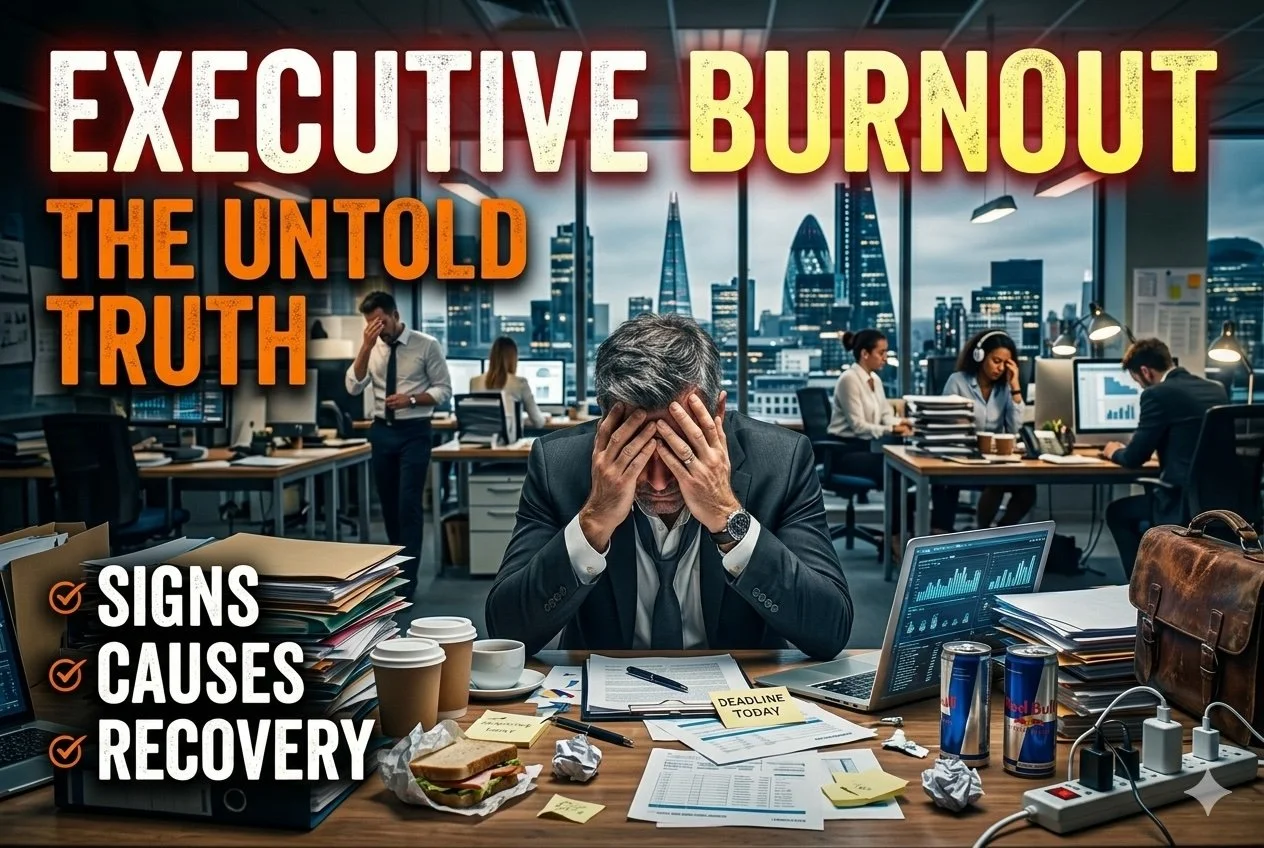
Most executives don’t burn out because they work too hard.
They burn out because they’re working hard on the wrong thing… in the wrong way… for the wrong reasons.
If you’re an experienced leader, you probably know the classic advice:
Take more holidays
Delegate more
Get better at time management
And yet, you come back from a week away and by Tuesday afternoon… you feel exactly the same.
In this video, I’m going to expose 3 burnout myths that keep senior leaders quietly cracking behind the scenes – even when everything looks successful from the outside.
If you recognise yourself in any of these, it’s not a sign of weakness. It’s a sign that you’ve been trained to lead from the outside in… and I’ll show you how to reverse that.
Burnout is now so normalised in senior leadership that it’s almost a badge of honour.
70-hour weeks
Back-to-back meetings
Always on, always reachable
And we’re told this is simply “what it takes” to lead at the top.
But here’s the uncomfortable truth:
Most executive burnout is not caused by the volume of work. It’s caused by the relationship you have with your work.
Two leaders can have the same schedule, the same responsibilities, the same pressure – and one is thriving while the other is on the edge of collapse.
What’s the difference?
It’s not their diary.
It’s their inner world.
In this article, we look at:
Why the idea that burnout is just about workload is dangerously misleading
How “loving your work” can actually increase your burnout risk
And the most insidious myth of all: that burnout is a personal failure
And for each myth, I’ll give you a practical “Inside Out” shift you can start using immediately.
Let’s get into Myth 1.
You’ve heard this a thousand times:
“You’re working too hard. You just need more rest. Take a break.”
Now, of course, sleep and rest matter. But if it were simply about hours, then:
Every surgeon,
Every founder,
Every CEO,
working 60–70 hour weeks would be burned out.
They’re not.
So what’s actually going on?
Burnout research consistently points to mismatch:
Mismatch between your values and your role
Mismatch between your sense of control and your responsibilities
Mismatch between the demands on you and the sense of meaning you get in return
You can tolerate long hours if:
You feel aligned with what you’re doing
You feel you have real agency
And you feel your effort genuinely matters
You start to crack when your day looks like this:
Endless meetings that don’t move the needle
Firefighting problems that keep repeating
Saying yes to things you don’t really believe in
Performing a role that no longer feels true to who you are
That doesn’t just drain your energy – it erodes your sense of self.
And that is far more exhausting than any 12-hour day.
Inside Out Shift #1: Audit Your Inner Workload
Instead of asking, “How many hours am I working?”, ask:
“What is the psychological cost of the hours I’m working?”
Here are three questions you can sit with – and if you’re willing, even journal on after reading this:
Alignment:
“Where in my week am I acting against what I know is right – for me, my team, or the organisation?”Agency:
“Where do I feel I have no real say, but still carry full responsibility?”Meaning:
“Which parts of my work feel genuinely meaningful – and which feel like theatre?”
You don’t have to change anything yet. Just notice.
Because the moment you see that your exhaustion is coming from inner conflict, not just outer workload, you stop trying to fix burnout with yet another productivity hack.
You start realising: “It’s not just my calendar that needs changing. It’s the way I’m showing up to my calendar.”
We’ll come back to how to shift that. But first, let’s tackle Myth 2.
MYTH 2 – If You Love Your Work, You Won’t Burn Out
This one is especially dangerous for high-performers.
You care deeply.
You’re committed.
You may even feel called to your work.
And so when you start to feel exhausted, resentful, or empty, you tell yourself:
“This doesn’t make sense. I love what I do. I just need to push through.”
So you push. You override the early warning signs:
The Sunday evening dread that never used to be there
The increasing irritability with your team or family
The feeling that you’re constantly “on”, even when you’re physically off
And because your role is meaningful, you use that meaning as justification to sacrifice more and more of yourself.
“I’ll slow down when this project is over.”
“I’ll rest when we’ve finished this restructuring.”
“I’ll be present at home once we’ve closed this deal.”
You become the last person you take care of.
The Passion Trap
Here’s the paradox:
The more your identity is fused with your work, the more vulnerable you are to burnout.
If your inner narrative sounds like:
“I am the business.”
“If I stop, it all falls apart.”
“My worth is my performance.”
Then you’re not just leading an organisation - you’re trying to prove your right to exist through it.
And that is an impossible load to carry.
It’s why so many brilliant leaders wake up one day thinking:
“I built all of this… why do I feel nothing?”
The outer success is there. The inner connection is gone.
Inside Out Shift #2: Separate Who You Are from What You Do
Self-leadership begins with a simple but profound distinction:
“My role is what I do. It is not who I am.”
So here’s a practice:
Next time you introduce yourself – even if just in your own mind – don’t start with your title.
Instead of: “I’m the CEO of…” or “I run…”
Try something like:
“I’m someone who is deeply curious about…”
“I’m someone who cares about…”
“I’m someone who’s learning to…”
This might feel awkward at first, but what you’re doing is loosening the grip of identity around your role.
Then ask yourself: “If my title disappeared tomorrow, what qualities would remain?”
– Clarity?
– Courage?
– Curiosity?
– Compassion?
These qualities are part of who you are.
They can be expressed through your current role – or through something entirely different.
Why does this matter for burnout?
Because when you realise: “My worth doesn’t live in my inbox, my diary, or my job title…”
You no longer have to exhaust yourself to protect them.
You can start making decisions that honour your wellbeing without feeling like you are destroying your entire identity.
We’ll bring this together in Myth 3 – the one that keeps so many senior leaders suffering in silence.
MYTH 3 – Burnout Means You’re Not Tough Enough
This is the quiet story that keeps executives stuck.
You’ve been rewarded your entire career for:
Being resilient
Being dependable
Being the one who can “handle it”
So when the cracks appear – when concentration slips, when your patience evaporates, when you wake up at 3am worrying about things you used to take in your stride – the inner narrative kicks in:
“Maybe I’m just not cut out for this anymore.”
“Other leaders are handling more than I am – what’s wrong with me?”
And because you don’t want to be seen as weak, you either:
Double down and push harder
Or quietly withdraw – emotionally, mentally, sometimes physically
Neither of those paths leads anywhere good.
Here’s what most leaders don’t see: Burnout is not a verdict on your character. It’s feedback on your current way of leading yourself.
When you ignore that feedback, your system simply turns up the volume:
More anxiety
More anger
More numbness
Until eventually, it forces you to stop.
Not because you’re weak, but because you’ve been operating an Outside-In model of leadership for too long.
The Outside-In Trap
The Outside-In model sounds like this:
“I must meet expectations.”
“I must protect my image.”
“I must keep everyone happy.”
Your reference point is always out there:
The board
The market
The team
The shareholders
Your peers
You shape yourself to fit those demands, often without even realising you’re doing it.
The Inside-Out model reverses that:
“What is actually true for me here?”
“What am I pretending not to know?”
“What would integrity look like in this decision?”
Now, instead of outsourcing your sense of self to the role, you bring yourself to the role.
And here’s where burnout becomes something very different.
Inside Out Shift #3: Treat Burnout as a Signal, Not a Sentence
When you notice signs of burnout – emotional exhaustion, cynicism, feeling ineffective – instead of asking: “What’s wrong with me?”
Ask: “What is my system trying to tell me that I keep ignoring?”
This is a radically different question.
It assumes:
You are fundamentally intact
Your inner system is intelligent
The symptoms are signals, not failings
You might discover, for example, that:
You’ve been tolerating a misaligned role because it looks impressive
You’re carrying emotional labour for your team that doesn’t belong solely to you
You’re saying yes when you mean no, because you’re afraid of disappointing others
In other words:
Burnout isn’t you failing at leadership - it’s your current way of leading you that’s failing you.
And that can change.
If you're reading this and thinking: "Some of this is definitely me, but I'm not sure how bad it is or where to start."
I've created something specifically for that. It's called the Inner Leadership Mastery Profile. a short practical scorecard that helps you see exactly where you're leading from the outside in and where you're already leading from the inside out.
It only takes a few minutes and you'll get a clear breakdown of the specific patterns that are increasing your burnout risk, where your self leadership is already strong, and the one or two shifts that would make the biggest difference.
You can access it here. If you're serious about staying in the game without losing yourself in the process,
BRINGING IT TOGETHER
Let’s pull the three myths together:
“Burnout is about hours.”
No – it’s about inner conflict and mismatch.
You can’t time-manage your way out of being fundamentally misaligned.“If you love your work, you’re safe.”
No – passion without boundaries is a fast track to self-erasure.
You must separate who you are from what you do.“Burnout means you’re weak.”
No – it means your current strategy for self‑leadership has reached its limit.
It’s feedback, not a final judgement.
And underneath all three myths is one core shift:
Moving from an Outside-In life, where you’re constantly reacting to external demands…
To an Inside-Out life, where your actions are anchored in clarity, integrity and self-awareness.
When you do that, something remarkable happens:
Your decisions become cleaner
Your boundaries become clearer
Your energy becomes more stable
Not because the world has become easier, but because you have stopped abandoning yourself in order to survive it.
If you’ve recognised yourself in any of this, here’s the most important thing to take away: You don’t have to wait for a full collapse to change direction.
Your system is already giving you signals – tension, tiredness, irritability, numbness. The question is whether you treat those as annoyances… or intelligence.
If you want to go deeper into this:
Watch my next video on Why Leaders Are Breaking: The Outside-In Trap – that will give you a much clearer map of how this pattern shows up in your leadership.
And if you’re a senior executive or entrepreneur who knows you’re close to the edge and you want structured support to rebuild your leadership from the inside out, just drop me a line through the contact page
If this has been useful, sign up for more:
You’ll get more content on self-leadership, emotional mastery, and conscious decision‑making
You’ll also be quietly pushing back against a culture that still believes burnout is just “part of the job”
And if there’s a specific situation you’re wrestling with – a role that no longer fits, a team that’s draining you, a decision that’s costing you sleep – drop it in the comments, even in broad terms.
I read them, and they often shape future content.
Thanks for reading, and remember:
The most important organisation you will ever lead… is yourself.