
Successful But Unhappy? You're Getting a Signal
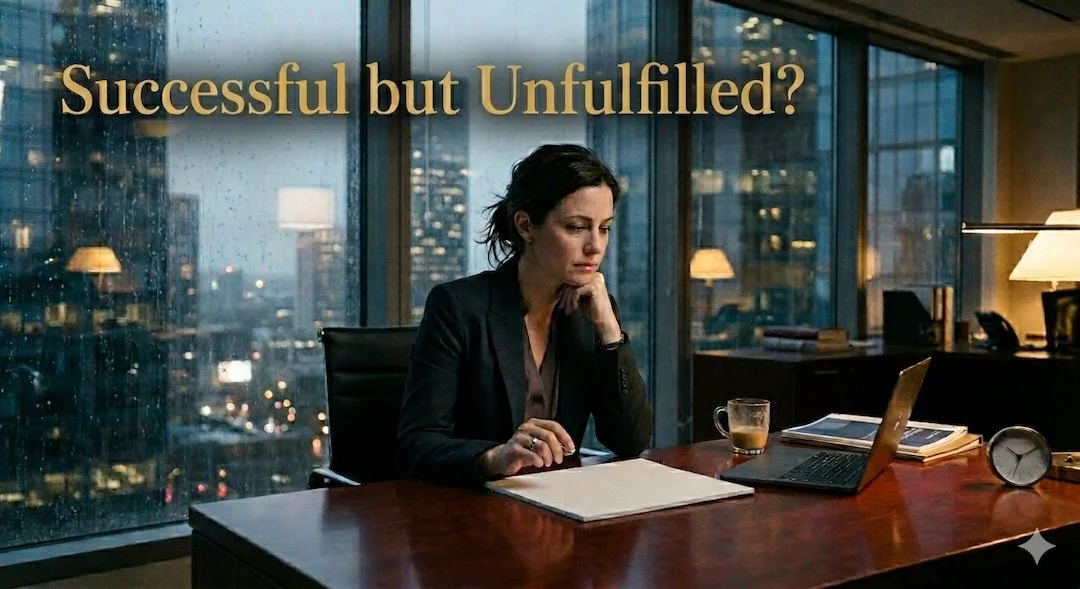
Have you ever felt the glow of success - and at the same time, a strange and gnawing dissatisfaction? A sense of achievement accompanied by a feeling of incompleteness, of emptiness?
If you have - and many of my clients do - consider yourself fortunate, blessed, even. Because you're feeling something most people can't: a signal swamped by noise.
In this article, I'll explain exactly why this happens, why most people don't listen to it, and how to respond.
Success is the achievement of a goal, an aspiration, and the feeling is unmistakable, ranging from a quiet sense of satisfaction to a euphoric elation at your personal triumph. If you’re alert, you’ll notice the gentle but inexorable fading of the feeling to the point where it’s no longer relevant.
Success has a half-life - just like a radioactive element, it decays over time. But unlike Uranium, with a half-life measured in billions of years, the glow of success fades rather more quickly, sometimes registering as a mere blip in our lives.
And that would be fine if we did not rely on the feeling of success to satisfy us - if we were not addicted to the hormones that accompany every win. But many of us are, craving another hit from the next contract, deal, promotion or pay-rise.
Success is like sugar - empty calories that deliver a buzz but leave you feeling flat and depleted. Long-term, the insulin spikes that sugar triggers create an insulin resistance that culminates in metabolic disorders, diabetes and worse.
In complete symmetry, a reliance on success to provide emotional calories eventually leads to a resistance that numbs the response, creating psychological disorders such as anxiety, burnout and depression, making it impossible to achieve the very success that is yearned for
When the highs fade, they quite naturally leave you feeling low - empty, unfulfilled and unsatisfied. That is an inner signal telling you that the strategy is not working - that the sugar or success don’t satiate and certainly don’t nourish - they just leave you wanting more. But the noise of the world outside drowns out the signal and entices us to seek more gratification from the same place.
And so we continue in a repeating cycle of glut and lack, of boom and bust, until the emptiness we’ve been ignoring can be ignored no longer and the signal becomes greater than the noise could ever be.
To begin with, it’s far easier to act on the urge for more, than to listen to the subtle sense of disquiet that can follow success. Fortunately, if we don’t listen, life conspires progressively to compel us to listen. But make no mistake, that signal is there from the get go.
Now, I’m not for a moment suggesting that success is a bad thing - far from it - without success not much could happen in our human lives. The problem comes when we chase it to the exclusion of all else. So what else is there?
To answer this question, we need to discriminate between our inner and outer worlds. The outer world is that of outcomes, of effects, of results of success and failure - what William Blake referred to as this vegetable universe - “...and but a faint shadow” of our inner world. Everything in the outer world is transitory, ephemeral and subject to change. Our inner world, in contrast, is the light that casts the shadow, the cause behind the effects and the process behind the outcomes. It is life itself.
So chasing success is no different from mistaking a shadow for the thing itself and is guaranteed to leave you disappointed. The beauty of our human lives is that you have the agency to chase shadows if you choose, but ultimately it will never give you what you think you need from it. It’s a self-correcting system.
What you need is not out there somewhere in the future or past - it’s here and it’s now, within you. It’s alignment between what you are creating and what fulfils you. Your vision and your purpose, if you like. Outcomes don’t fulfil, only activities can do that and that is because activities are here and now, outcomes are out there somewhere in the future, or in the past.
In other words, if you’re gritting your teeth long-term, solely to get a result you think will please you, you’re on a hiding to nothing. Ask an olympic athlete what that does for their psychological wellbeing.
All of this still begs our original question: how do you respond, or where do you focus your attention if not on the prize itself?
The first step is to ensure that whatever you do is aligned with your sense of purpose. We all have things we enjoy doing for their own sake - it could be making pancakes or running companies, it doesn’t matter. Life gets much easier when you are able to express your sense of purpose in a way that is meaningful to you.
Step 2 is to build a vision of what you want to create - an outcome - which is congruent with your purpose. You will know when you have it - it will feel right.
Step 3 is to take action and keep going…
When these 3 factors are in place, there is no success or failure, just a relentless progress towards your vision. The means becomes an end in itself - fulfilment and satisfaction become independent of the outcome. The process feels successful, whatever the outcome.
If you feel a deep resistance to what you’re having to do to meet your goal, don’t just keep plodding on and toughing it out. Ask yourself if this is really how you’re wanting to spend your life to achieve your objectives. Ask yourself if what you do expresses your sense of purpose, or if it’s just a means to end.
Sure - sometimes we have to grin and bear some adversity, but it’s a short-term tactic not a long-term strategy. When the end is all you have to keep you going, then the end justifies the means, and that’s a dangerous place to get to.
The most common situation for us to end up with misaligned activity of this sort is earning a living. There is a common and deeply-held belief in many quarters that doing what you love doing - and getting paid for it - is a luxury for only the privileged few. If that is what you believe, so will it be true - at least for you.
You won’t necessarily be able to resign your job today in order to sell dream-catchers in Bali tomorrow, but you can start to plan a transition to whatever floats your boat, right now. And, of course, you don’t have to monetise your passion - there are plenty of examples of those that earn a humdrum living whilst living their dream as a hobby or pastime.
But there is no reason why everything you do can’t resonate with your sense of purpose.
As Henry Ford said: Whether you think you can, or you think you can’t you’re right.