
Why Popular Leadership Advice Is Making You More Stressed
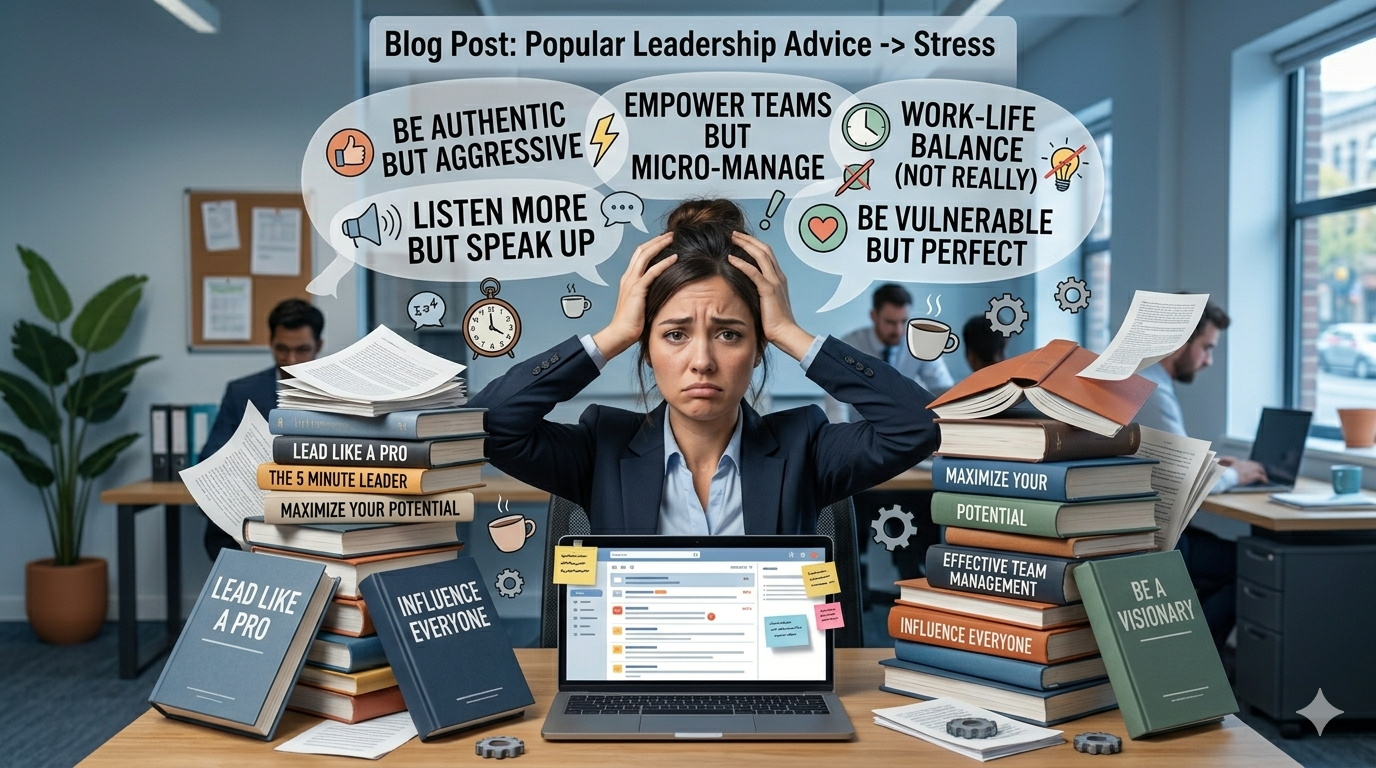
You've read every leadership book. You've attended the seminars. You've implemented the frameworks. And yet you're more stressed than ever. Here's what nobody's telling you: the problem isn't your execution. It's that you're trying to fix an inner problem with outer solutions.
Let me start with something you've probably experienced. You implement a new system. Maybe it's Objectives & Key Results - OKRs. Maybe it's radical transparency. Maybe it's a new meeting structure. For two weeks, it feels absolutely brilliant. You feel organised. You feel in control and like you've finally cracked it. Then something happens: a difficult conversation comes up; a team member underperforms; a deadline slips. Suddenly, the system doesn't matter anymore. Your stress comes back. Your anxiety returns. And you're left wondering why the thing that was supposed to fix everything didn't actually fix anything. Why? Because the system was never the actual problem.
The Centre for Creative Leadership found that 60 per cent of leaders who implemented new management frameworks reported increased stress within six months. Not decreased. Increased. They had better systems, clearer metrics, more structure, better visibility into what was happening across their organisations. And they were more stressed than before. Why would that be? The framework doesn't address what's actually driving the stress.
I worked with a CEO from a FTSE 250 company not long ago. She'd implemented everything you could possibly imagine. Agile frameworks across the organisation. Quarterly planning cycles. OKRs in every single department. Her metrics looked absolutely perfect. Team engagement scores were up. Revenue was climbing. By every external measure, she was crushing it. But she was exhausted. She'd wake up at three in the morning worrying about whether her leadership was good enough. She'd second-guess every decision she made. She'd feel like a fraud running a successful company. One day she said to me, and I'll never forget this: 'I've optimised everything except myself.' That's the real problem right there. The frameworks assume you're fine. They assume the issue is out there, somewhere external - in the structure, the process, the metrics, the systems. But the stress you feel? That's not coming from out there. That's coming from in here. From how you think about yourself. From your role. From your ability to handle uncertainty and the unknown.
Popular leadership advice is built on a false assumption. The assumption is that stress and anxiety are symptoms of poor systems. They're not. They're symptoms of misalignment between who you're trying to be as a leader and who you actually are. You can't framework your way out of that. A better calendar doesn't fix self-doubt. Clearer metrics don't fix imposter syndrome. Delegation doesn't fix the belief that you have to control everything to keep things from falling apart. These are inner problems, and they require inner solutions.
Now let's talk about something counter-intuitive. The more you measure, the more anxious you actually become. Think about it for a moment. When you had fewer metrics, when you had less visibility, you had more freedom. You had more space to breathe. You had more room to make judgement calls. But modern leadership says: measure everything. Track everything. Quantify everything. The theory is that visibility creates control. But it doesn't. It creates the opposite.
There's a famous case study from Microsoft under Steve Ballmer that illustrates this perfectly. The company introduced a stack-ranking system, which is essentially a forced curve where every manager had to rate their employees on a distribution. The top performers got the best reviews and bonuses. The bottom performers got fired. It sounds logical when you think about it. Measure performance. Reward excellence. Identify the weak links. But what actually happened? Collaboration collapsed. People stopped helping each other because helping a colleague might lower your own ranking relative to theirs. Innovation slowed down because people focused on metrics they could hit rather than risks worth taking. The system was measuring the right things on paper, but it was destroying the culture. Why? Because people respond to what's measured. And when what's measured doesn't reflect what actually matters—like trust, creativity, psychological safety, genuine collaboration—the system backfires spectacularly.
A study from the University of Manchester found something really interesting. Leaders who tracked more than fifteen key performance indicators reported 40 per cent higher stress levels than those who tracked three to five. Why would that be? Because the human brain can only hold so much in focus. Beyond that point, every additional metric becomes background noise that creates anxiety without clarity. You're constantly aware that something isn't being measured properly. Something's slipping through the cracks. Something important is being missed.
Metrics create an illusion of control. You think: if I just measure the right things, I'll understand what's happening, and I'll feel safe. I'll know what's coming. I'll be able to prevent problems. But metrics are a lagging indicator. They tell you what happened, not why it happened. And they don't tell you anything about the quality of your leadership or the strength of your relationships. You can hit every single metric and still have a team that's burned out, disengaged, or about to leave. The stress comes from chasing a number that will never feel like enough. There's always another quarter. There's always another target. There's always another metric that's not quite where you want it to be.
Here's what actually changes things: stop asking what you should measure and start asking what you need to understand. There's a real difference between those two questions. Understanding comes from conversation, observation, and genuine feedback. Metrics are a tool, but they're not a substitute for knowing your people. And they're definitely not a substitute for knowing yourself - your triggers, your patterns, your fears as a leader.
Now let's talk about technique. You know how to have difficult conversations now. You've done the courses. You've learned the frameworks. You know the techniques. You know you're supposed to listen more than you talk and to ask open questions. You know you're supposed to create psychological safety. You know all of this intellectually. And yet, when you're in the moment with a team member who's underperforming, none of that feels natural. It feels like you're performing. It feels like you're acting. And that discomfort you feel? That's the clue that something's wrong.
I worked with a director at a government organisation. He'd done the coaching course. He'd learned the active listening technique. He'd learned how to ask powerful questions. He'd learned how to reframe situations. But when he sat down with a struggling team member, he felt like a complete fraud. He was doing all the right things, saying all the right things, but it felt hollow. The team member could sense it. She knew he didn't actually believe in her. He was going through the motions because that's what the training said to do. The technique was perfect. The execution was flawless. The outcome was terrible. Why? Because technique without genuine belief is manipulation. And people feel that immediately. They sense it. They know you don't actually believe what you're saying.
Research from Harvard Business School shows that leaders who rely heavily on learned techniques without authentic belief have 35 per cent lower trust scores with their teams compared to leaders who lead from genuine conviction, even if those leaders are less technically skilled. People would rather follow someone who's authentic and slightly clumsy than someone who's technically perfect but clearly not genuine.
The real issue isn't that you don't know the techniques. It's that you don't believe them. You don't believe that people are capable of figuring things out. You don't believe that vulnerability is strength. You don't believe that you can lead without controlling. You don't believe that you can be uncertain and still be a good leader. And no amount of technique training will change that. In fact, technique training without inner work just gives you a more sophisticated way to hide. You're not actually different. You're just better at looking the part. You're just better at performing the role of a leader whilst still being anxious underneath.
Which brings us to the real problem. And this is the part that changes everything if you're willing to see it.
Your stress isn't coming from your systems. It's not coming from your metrics. It's not coming from your lack of technique. It's coming from a belief. A specific belief about what it means to be a good leader. And until you examine that belief, until you actually look at it directly, no framework will ever feel like enough. No amount of optimisation will ever feel complete.
I worked with a CEO who was drowning. She had a team of 50 people. She was checking emails at midnight. She was cancelling holidays. She was losing sleep. Her relationships were suffering. Her health was suffering. When I asked her why she was doing this, she said: because if I'm not on top of everything, things fall apart. That's the belief. I'm responsible for everything. If anything goes wrong, it's my fault. If anyone struggles, I should have prevented it. If anyone's unhappy, I need to fix it. That belief is absolutely exhausting. Because it's impossible to live up to. You can't prevent everything. You can't control everything. You can't keep everyone happy. But if that's your belief about what makes you a good leader, you will spend your entire career stressed, because you're trying to do something that fundamentally can't be done.
Most of the stress that senior leaders feel comes from one of four core beliefs. The first is: I have to have all the answers. If someone asks me something and I don't know, I'm not a real leader. The second is: I have to keep everyone happy. If anyone's upset with me or unhappy in their role, I've failed. The third is: I have to be in control. If I'm not directing everything, if I'm not involved in the decisions, things will go wrong. And the fourth is: I have to prove my worth through achievement. My value as a person is determined by how much I accomplish, how much I deliver, how impressive my results are.
These aren't problems with your systems. They're not problems with your metrics. They're problems with how you see yourself. And frameworks can't touch that. Metrics can't measure that. Techniques can't fix that. Only you can. By looking at where these beliefs came from. By questioning whether they're actually true. By deciding who you actually want to be as a leader, independent of what you think you're supposed to be.
Here's what inner work actually means in practice. It means examining your own thoughts, feelings, and patterns. It means noticing when you're stressed and asking yourself a different question. Not 'How do I fix this situation?' but 'What am I believing about myself right now that's making me stressed?' Sometimes the answer is 'I believe I should know this already.' Sometimes it's 'I believe that if I admit I don't know, people will lose respect for me.' Sometimes it's 'I believe that my value is determined by how much I achieve.' Sometimes it's 'I believe that if I'm not involved, things will go wrong.' Once you see the belief, you can question it. Is it actually true? Is it actually serving you? Is it actually who you want to be? That's the work. And it's uncomfortable. It requires you to be honest with yourself. But it's the only work that actually changes anything.
So what does this actually look like in practice? How do you lead differently when you've started to see these patterns in yourself? It starts small. It starts with noticing. The next time you feel stressed, don't reach for a new system or a new framework. Pause. Notice the feeling. Ask yourself: what am I believing right now? What am I afraid of? What would it mean about me if this thing I'm worried about actually happened? Most of the time, the fear underneath isn't about the situation itself. It's about what the situation means about you. Your competence. Your worth. Your ability to lead. That's where the real work is.
The CEO I mentioned earlier - the one who was waking up at three in the morning - she started noticing that her stress peaked when she didn't have all the information about a project. That's when she'd start checking in more, asking for updates, getting involved in the details, micromanaging without meaning to. We traced that back to a fear: if I don't know what's happening, I'm not in control. If I'm not in control, things will go wrong. If things go wrong, it's my fault. Once she saw that pattern clearly, she could question it. She started experimenting. She stopped asking for daily updates on certain projects. She let her team make decisions without her approval. She created space for them to figure things out. And you know what? Things didn't fall apart. In fact, her team got better. They made better decisions. They learned faster. They felt more trusted. They took more ownership. And her stress dropped by 60 per cent within three months. Not because she implemented a new system. Not because she hired a coach to teach her better techniques. Because she changed her belief about what she needed to do to be a good leader.
Start here with this. Identify one area where you're consistently stressed. One situation that regularly triggers anxiety. Maybe it's delegation. Maybe it's giving feedback. Maybe it's when things don't go according to plan. Now ask yourself: what would I have to believe about myself for this to stress me out? What would need to be true? Write it down. Really look at it. Don't judge it. Just observe it. Is that belief actually true? Is it actually serving you? Is it actually helping you be the leader you want to be? If not, what would you like to believe instead? That's not positive thinking. That's not affirmations. That's genuine inquiry into how you're constructing your reality as a leader. And that's where change actually starts.
Which of those four beliefs resonated most with you? Was it 'I have to have all the answers'? Was it 'I have to keep everyone happy'? Was it 'I have to be in control'? Or was it 'I have to prove my worth through achievement'? Drop it in the comments. I want to know which one you're carrying. Which one's been running your leadership life.
If you're ready to do this inner work properly - to actually examine the beliefs that are driving your stress instead of just managing the symptoms - I've created a scorecard called 'The Inner Leadership Master Profile.' It walks you through the inquiry I've described in this article, with real prompts and questions you can work through. Download it now using the link in the description. It's free, and it'll give you a structured way to start understanding what's actually happening beneath the stress. What beliefs are actually running your leadership.
Subscribe to this channel if you want more articles about real leadership. Not the frameworks and techniques, but the actual inner work that changes how you show up as a leader. I publish every other week, and each article is designed to help you lead with more confidence, clarity, and ease. Thanks for reading.