

The Inner Game of Life
How life, thought and leadership are inextricably entwined

For aeons, the greatest thinkers have agonised over life, what it is and what it means. But life isn't for thinking about, it's for living.
In fact, thinking about life is like trying to bite your own teeth. Thinking can never encompass it. Whatever we think life is, that's a thought and cannot be life itself...
Which begs the questions:
How often do we mistake a thought about something, for the thing itself?
What if our thinking is obscuring our perception of reality?
What would reality look like without the thinking?
Let's hear what Eckhart Tolle, the author of The Power Of Now, has to say on the subject:
💡 Words have meanings...
No surprise there - but frequently the original meanings can reveal further insights. Throughout the chapters, we'll be using the origins of words - etymology - to deepen understanding. (not to be confused with entomology, the study of bugs)
? Did you know that the word nice in the late 13c. meant "foolish, ignorant, frivolous, senseless, careless, clumsy; weak; poor, needy; simple, stupid, silly, foolish," from Latin nescius "ignorant, unaware," literally "not-knowing"?
Now you can use the word as an insult without anyone else knowing!
But on a more serious note, revealing the deeper meaning of a word can create a more complete picture of what it represents. For instance, the word individual is commonly held to mean a single person, considered separate from a larger group. Whereas the original meaning was inseparable as in: indivisible.
So the word has nothing to do with a person being separate from others and everything to do with being complete in themself - impossible to split into parts.
Please don't try.
Instead, let's consider the words in the title: The Inner Game of Life:
-
The word Inner hardly needs defining - but if there's an inner, there must be an outer. One can't exist without the other. So, as humans, if we have an inner aspect and an outer one, what are they and what is their relationship?
-
Is life really a game? It doesn't feel like one at times. Yet at others, it can feel delightfully playful, fulfilling - even blissful. To what extent does our perception of life - the lens we perceive it through - impact our experience of it?
The original meaning of game was participation or communion, giving a sense of "people together." So maybe life really is a game. -
The ultimate question: - What is Life? - is one which cannot be answered in words. But we don't need words - we are already living the only answer there could ever be to that question.
What's this got to do with Leadership?
“Who looks outside, dreams; who looks inside, awakes.”

-
Many of us experience an inner dialogue or an inner voice. Often it can be quite judgemental and is sometimes referred to as the inner critic.
Become aware of it now and observe it for a few moments.
Is that voice you?
Most of us identify with it and are the voice much of the time but, as Eckhart Tolle says:
"What a liberation to realise that the 'voice in my head' is not who I am. Who am I then? The one who sees that."
-
Close your eyes and imagine being completely alone - isolated from everything and everyone outside you - 'wandering lonely as a cloud'.
How does it feel? Does it feel lonely? Does it make you anxious?
Now consider that any sense of lack or need is simply the result of forgetting who you really are - and that who you really are is already complete.
After all, you're both individual and indivisible.
-
Find a quiet, comfortable spot where you can sit down and close your eyes. Do that and watch your breathing for a few seconds - in and out.
Wait for the energy of what you were doing before to calm down.
Now spend a couple of minutes watching your thoughts drift in and out of your mind.
Resist any urge to follow them - just let them go on their merry way, like puffy, white clouds against a clear, blue sky.

Now let's listen to Alan Watts - a famous British writer, speaker, and self-styled "philosophical entertainer", known for interpreting and popularising Buddhist, Taoist, and Hindu philosophy for a Western audience. Enjoy his plummy tones!
💡 Alan Watts makes a good point -
one that goes back a long way and aligns perfectly with Eckhart Tolle.
Many of us believe that being busy is a good thing. Busy originally meant anxious - funny that! So the busyness (business?) that we devote our lives to just creates anxiety.
There's a famous Psalm that goes: "Be still, and know that I am God". The original Hebrew word for "be still" means to slacken, let go, or drop your grip.
Which is why you can't quieten your mind by trying. Any attempt to make your mind still just stirs it up again. You have to let go - quite a challenge for us humans in the grip of the compulsive habit called activity.
ClaritySpace content is not 'linear'. It doesn't go from subject to subject in a neat, orderly fashion, 'finishing' one topic before starting the next.
That is the western form of pedagogy (the method and practice of teaching).
Instead, the content is more of a spiral, revisiting themes again and again - but from different perspectives.
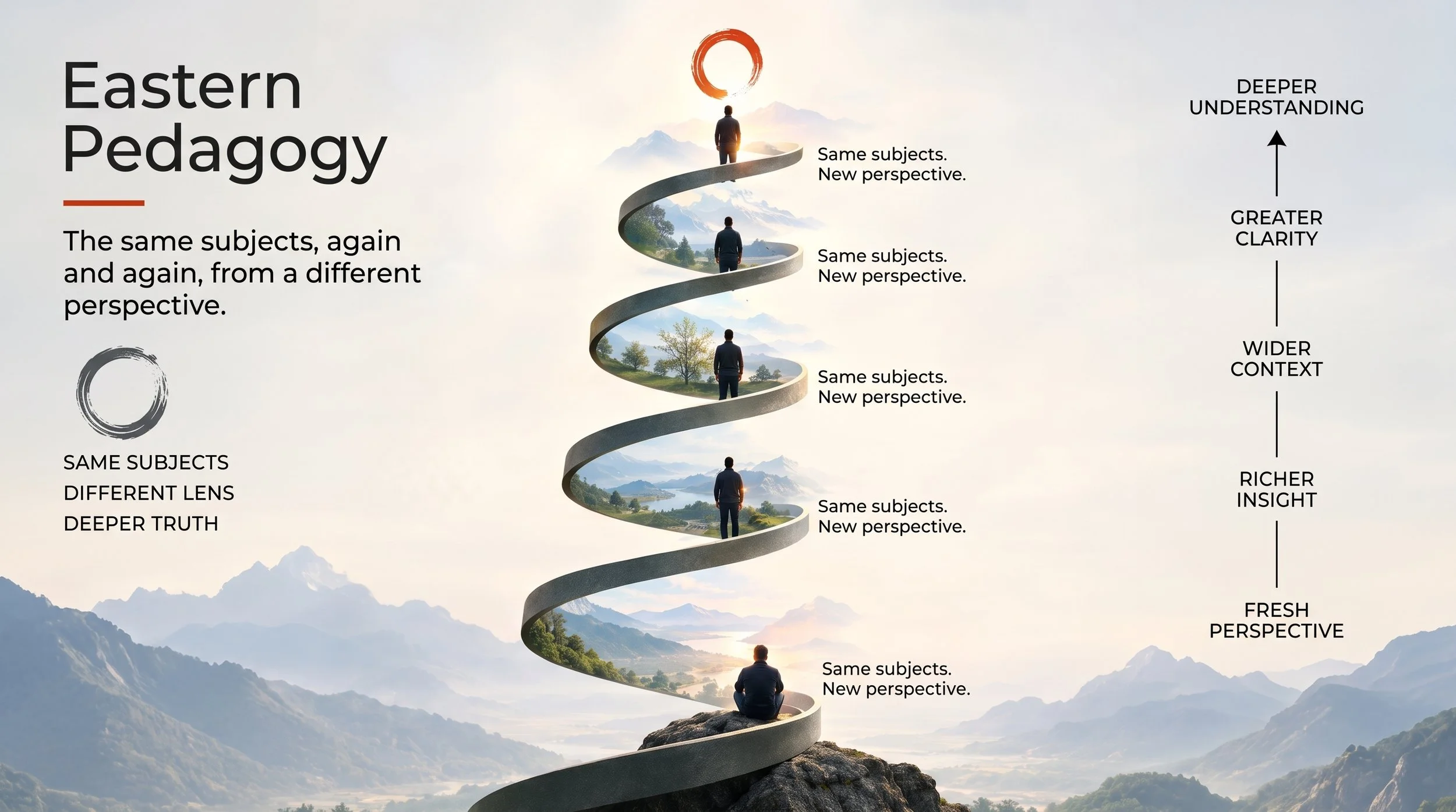
So don't be concerned if the content doesn't follow a predictable track. That's deliberate.
If you knew how your life was going to unfold, it wouldn't feel like life at all. So this content needs to emulate life to feel alive and to keep you engaged.
Having said that, rest assured that the themes and subjects we explore will be central to life and leadership.
💡 Make the most of this stuff -
Revisit this and subsequent chapters. The content is not only dense - packed with insight - it offers up new wisdom each time you access it.
That’s not because the content changes, but because you do. Everyday, you will see things through a slightly, or very different lens and be able to discern something new.
If you find that some things challenge you or make you uncomfortable, that’s a good thing.
The purpose of ClaritySpace is not to replace your ideas, opinions and belief-systems with other, ‘better’ ones. The purpose is to give you the opportunity to relax your grip and hold ideas lightly - to see them for what they truly are.
In this way, who you truly are will emerge with more speed and clarity.
This is Leadership ]Inside Out[